Then-President Bill Clinton signed the Timbisha Shoshone Homeland Act into law, in November 2000. Among other provisions, it returned ancestral land to the tribe, including a parcel of land in Death Valley National Park.
Now, 25 years later, the tribe is celebrating the act's passage. However, that celebration comes as the Department of the Interior is reviewing signage at the park’s visitors center that mentions the tribe.
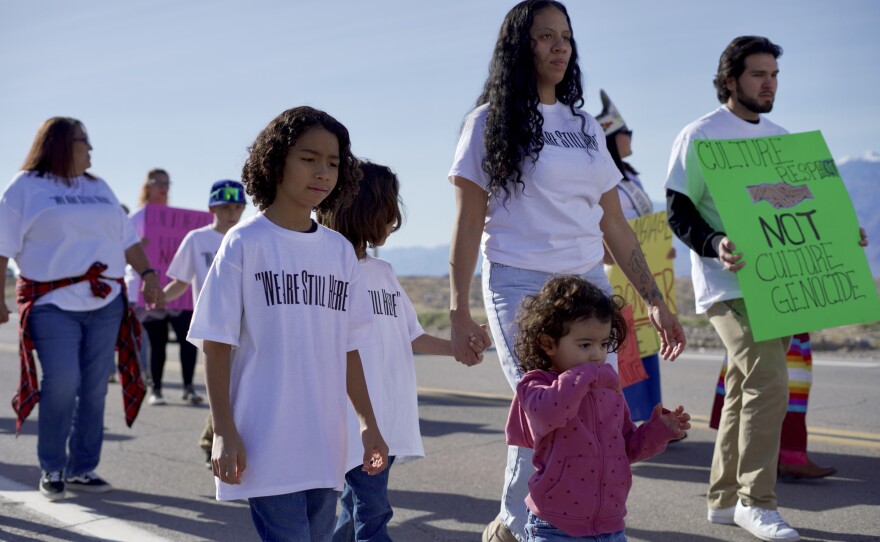
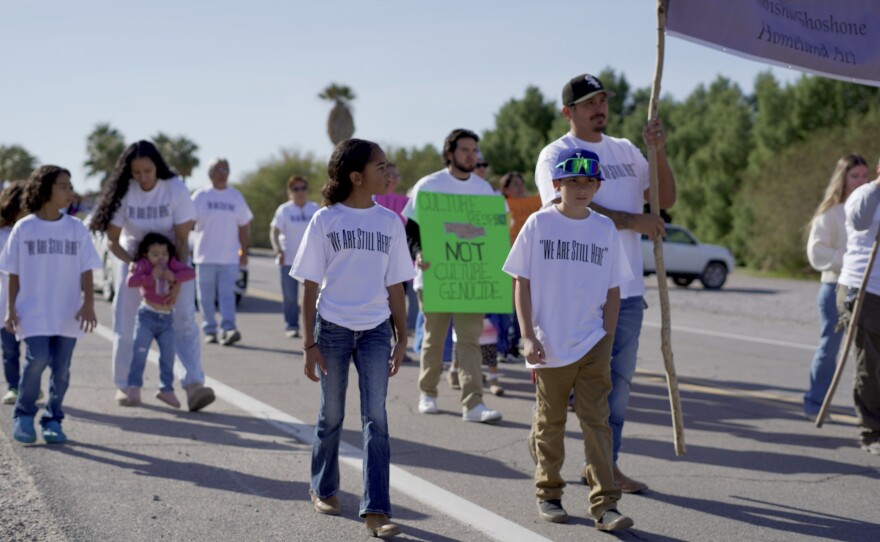
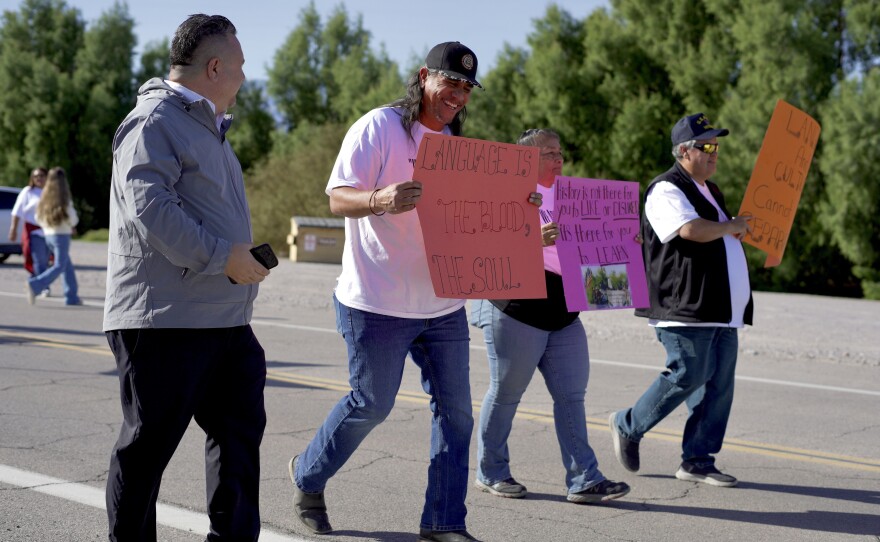
In response, more than 50 Timbisha Shoshone tribal members and supporters marched down the main road in Furnace Creek toward the Death Valley National Park Visitor’s Center on January 30.
That included Jimmy John Thompson, Timbisha Shoshone council member.
"We have 317 acres here within Death Valley National Park where we continue to live,” Thompson said. “And we want to make that statement. We are still here.”
He was part of a demonstration honoring the passage of the Timbisha Shoshone Homeland Act. It returned five parcels of ancestral land to the tribe. While most of their sovereign land is in Nevada, one parcel is within the national park.
He’s proud of those five parcels of land.
“Timbisha is one of the only tribal nations in this country who was able to sue the Department of Interior and get trust lands within a national park,” Thompson said.
Originally, the tribe planned to hold a ribbon-cutting for an updated exhibit inside the park’s visitors center, celebrating the 25-year anniversary of the passage of the Homeland Act.
Instead, that celebration turned into a protest when the Department of the Interior placed the signage under review.

That’s because President Trump signed an executive order last March, asking the Department of the Interior to remove all signage that “inappropriately disparages Americans.” So far, the department has removed signage at 17 national parks. In those cases, the signage included language that described slavery, climate change, and Native American history, according to Outside.
In Death Valley, phrases like “This is our Homeland” prompted the review.
Thompson said he doesn’t understand the problem.
“We have a display there currently, they want us to change the language in it,” he said. ”They wanted us not to use the word homeland, even though the name of our act is the Homeland Act.”
For some, removing the signage is yet another effort to erase their past.
Before the Homeland Act went into effect, the federal government considered the Timbisha Shoshone “squatters” on the land. And in a place where 140 days a year are at or above 100 degrees, many who lived there migrated to nearby mountains during the summer.
According to the tribe's secretary-treasurer, George Golson, the Park Service would use that opportunity to remove any signs of them from the area.
“After they left, then the [National Park Service] would literally come in with a water hose and wash the house away,” he said.
Golson said the relationship between the tribe and the Park Service at that time was tumultuous, at best.
“We had to hide,” he said. “My mom, she moved us away from the reservation because she didn't want us treated like she was treated. So we moved out into a different area. And I think that culturally we had to hide some of our stuff from being destroyed.”
That relationship has since changed. It’s now been 25 years since the Timbisha Shoshone regained the rights to their homeland and no longer have to worry about the government tampering with their homes.
That’s part of the reason why the Timbisha Shoshone people chose to celebrate the Act becoming law, now.
Thompson said it’s unfortunate that those who worked so hard to see the land returned weren’t able to see how far the tribe has come since then.
“When they did this, they were elders themselves 25 years ago,” Thompson said. “So unfortunately, most of them are no longer with us. And that saddens me honestly, to know that we did not get this completed while they were still here.”
Their work has not gone forgotten.

Thompson doesn’t live on the reservation anymore, but he visits as often as he can with his daughter and grandkids. He said it’s important that this land feels like home to them, even when he’s gone.
“I always feel like I'm home when I come here,” he said. “Like I told my kids and my grandkids, you know, kick your shoes off, go walk out in that sand, leave your footprint. Your footprint now mingles with your ancestors. They're here, you're here.”
Thompson said the tribe will use this renewed focus on the land regained through the Homeland Act to build 50 new homes on the reservation. He said they’re also looking to develop economic opportunities that capitalize on the 2 million tourists who visit Death Valley National Park and the Timbisha Shoshone homelands every year.