In the back room of a fire station, Jill Ridenhour opens a package. Printed on the side, in all caps, it reads “Human Blood.”
Ridenhour is a field supervisor for emergency medical services at Summit Fire and EMS in Colorado’s ski country. She pulls out a clear pouch filled with dark liquid and examines it.
“The color of the blood is good,” she said. “It's kind of dark red, purplish. There are no bubbles at the top.”
She puts the pouch in a special cooler.
This blood is called “whole blood.” It’s the centerpiece of a new idea: to let emergency responders give transfusions at the scene of an accident, instead of having to wait until patients get to the hospital.
Earlier this year, Ridenhour administered it for the first time to a trauma patient in the field.
“Her blood pressure was very low,” Ridenhour said. “As the blood was going in, you could just see her blood pressure improve. It was pretty neat.”
The patient was stabilized and taken to the hospital.
“There are times that no matter what we do, we can't help, and this is something that can give someone a fighting chance,” Ridenhour said.
Used by soldiers in World War I
Laura Harwood is a former trauma nurse and helped start the Colorado Whole Blood Coalition. For decades, she said, medics were trained to give fluids like saline.
“I keep referring to it as a revolution because it's an entire upending of the way that people think about it,” Harwood said.
Whole blood is special. When you get a transfusion at the hospital, it is usually split into components like plasma or platelets. Whole blood keeps it all together, which Harwood said is better. It can help stop bleeding and jumpstart recovery.
But whole blood isn’t entirely new – soldiers used it in World War I and it made a comeback during the wars in Iraq and Afghanistan.
“As those physicians and nurses and everybody started coming back, they started saying, ‘Hey, we should look at how to bring this to civilian trauma patients,’” Harwood said.

Research followed. One study showed receiving blood before getting to the hospital decreased patients’ chance of dying by 37%.
“There’s no other single variable that’s been associated with that strong of an impact,” she said.
The Colorado Whole Blood Coalition is working to get more fire and emergency medical service agencies on board – 15 have launched programs in the last two years.
First responders in Idaho, Utah and Nevada have started carrying the blood for the first time within the last six months. But across the country, only about 2% of EMS agencies do.
Keeping the blood pouches fresh, for one, is a daily task.
“They're in ready to go coolers that are conditioned every day to keep that temperature between 1 and 6 degrees Celsius the entire time,” said James Levi, who leads EMS for Red, White and Blue Fire in Breckenridge, which started its whole blood program alongside Summit.
He said the blood expires in about a month, so they need a steady supply. The Summit County agencies are working on agreements with a hospital to bring unused blood before it goes bad. Setting up these programs, though, is expensive.
A window to act
But the federal government is starting to invest, dedicating $80 million to pre-hospital blood programs with more grants on the way.
“Ideally, I think, this would just be a standard part of the trauma treatment for crash victims or other trauma victims,” said Jonathan Morrison, who leads the National Highway Traffic Safety Administration (NHTSA). “This can really save lives.”
He pointed out that more than 40% of people who die in car crashes are still alive when first responders arrive, meaning there’s a window to act. NHTSA recently listed expanding pre-hospital blood transfusion programs as one of the Trump Administration’s key road safety strategies.

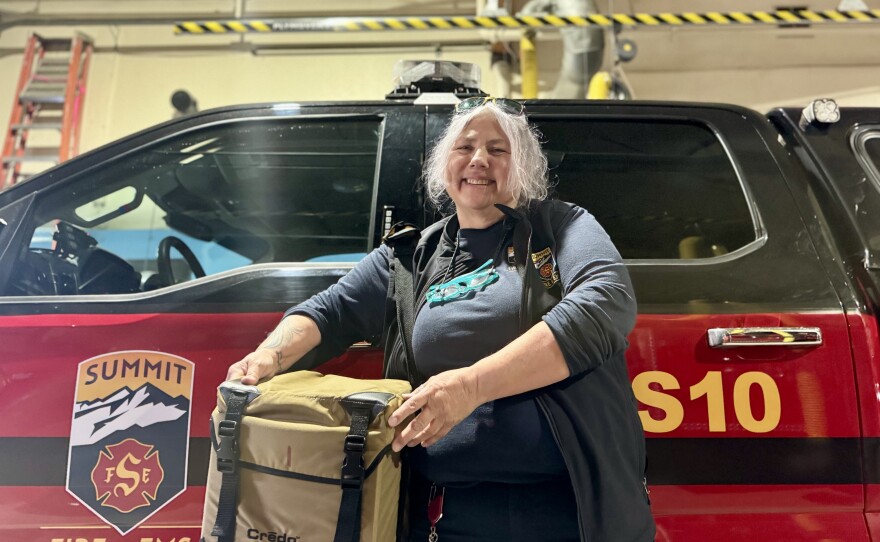

Whole blood has been administered 10 times in Summit County since it arrived on Christmas Eve last year. Ridenhour said her first patient recovered well at the hospital.
“For me, it was kind of one of the coolest things I’ve done in my career,” she said.
She says it’s a gift to be able to carry whole blood — and to know she can make a difference.
This story was produced by the Mountain West News Bureau, a collaboration between Wyoming Public Media, Nevada Public Radio, Boise State Public Radio in Idaho, KUNR in Nevada, KUNC in Northern Colorado, KANW in New Mexico, Colorado Public Radio, KJZZ in Arizona and NPR, with additional support from affiliate newsrooms across the region. Funding for the Mountain West News Bureau is provided in part by the Corporation for Public Broadcasting and Eric and Wendy Schmidt.