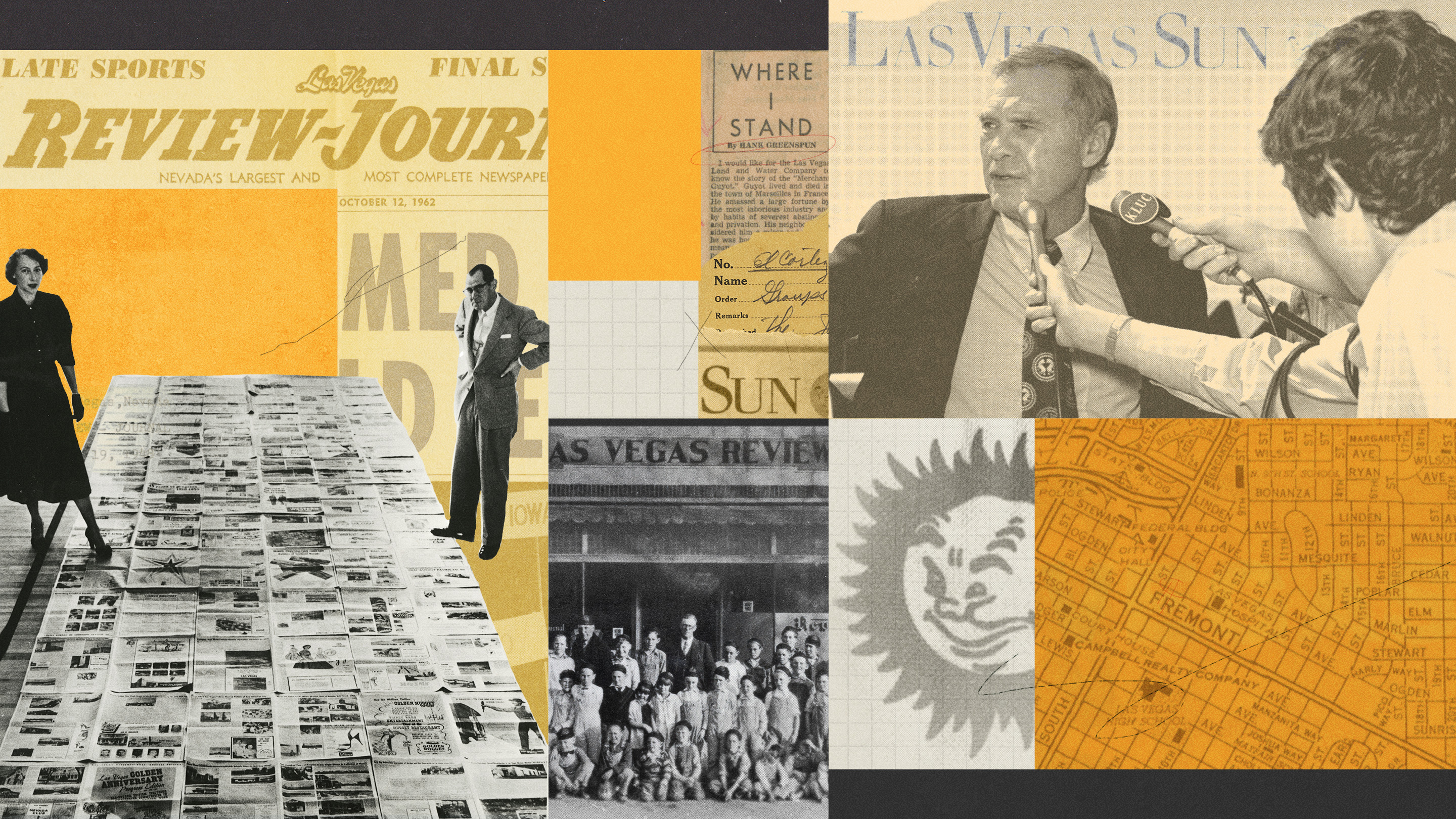


April 3 marked the first time in more than 75 years that Las Vegans had only one daily newspaper to read in print.
The owners of the Las Vegas Review-Journal, which had been printing the Las Vegas Sun since the two newspapers entered into a joint operating agreement in 1989, decided to stop inserting a Sun section into their daily paper. The move was the latest blow in a long-running legal slugfest between the two media organizations.
The Sun still exists online, but the abrupt demise of its print edition nevertheless represents another step away from a bygone era when local news consumers had two (and sometimes three) independent, hard-charging newspapers to read. From the Sun’s debut in 1950 until the internet completely disrupted the newspaper business in the early 2000s, the Review-Journal and Sun were battling for scoops.
The glory days, to those still around to remember them, were the 1970s and ’80s.
“The competition between the R-J, the Sun and even the local television stations was ferocious, each of them breaking stories,” recalls Jane Ann Morrison, who was a Review-Journal reporter and columnist from the mid-1970s until 2018. “If I got beat on a story, I heard about it and was expected to come back with a stronger story than the one I was beat on.”
Morrison describes that pre-internet period as “the richest days for Las Vegas reporters” because of the competition and the talented journalists who populated the newsrooms. “Both newspapers aggressively covered politics, local governments, state and federal courts, and had strong columnists,” she says.

This was the stirring environment in which I cut my teeth as a journalist. Fresh out of college, I arrived at the Sun in the spring of 1988. It didn’t take long to see that the newsroom was filled with characters and misfits. The old-timers fascinated me. Jerry Ralya, the city editor, had been a skilled reporter, but many nights he needed a designated driver to get home safely. Harold Hyman, a veteran police reporter, was notorious for stealing people’s lunches from the office refrigerator. Jim Barrows, the editorial page editor, was a renowned pipe-smoking piano player who delivered impromptu performances at a dive bar called Decatur Package Liquor.
But the Sun also had a growing crop of talented and motivated young turks for whom beating the Review-Journal was paramount. The pack leader was Jeff German, who covered organized crime, politics, and corruption as both a reporter and a columnist. Although German developed sources of his own, he also benefited from tips and insights provided by the executive editor, Mike O’Callaghan, the former Nevada governor.
The Sun was at its best when covering a big story. Art Nadler, a longtime Sun reporter, remembers when four Thunderbird jets crashed near Indian Springs in 1982.
“That happened around lunchtime,” Nadler says. “Me and a couple of friends were leaving for lunch, and we saw a mushroom cloud in the distance. We went back in, and the police radio was taking off like crazy. We all kicked into gear. The reporters all mobilized. We put out a special edition, and it was really good. That’s how the Sun was. With all the characters, we would all come together and knew what to do.”
The Review-Journal had a reputation as the newspaper of record (code for “boring”), but it fielded a power-hitting lineup of writers who set a high bar for the competition. Jon Ralston wrote about politics with attitude and skill; Morrison covered courtrooms infested with mobsters and corrupt politicians; and John L. Smith filed at least four columns a week, capturing the poetry and character of a unique city as no one had done before.

“The R-J was a little more sedate than the Sun,” Morrison says. “I think people at the R-J were more professionally minded and planning to move on (to larger newspapers). People did tend to move on after a while, maybe because it wasn’t as much fun.”
Chris Chrystal worked at the Review-Journal and the Sun from the late 1960s through the late 1970s. At the Sun in that era, its legendary publisher, Hank Greenspun, was an active participant in daily news coverage.
“Those were the days when you could really be a reporter,” Chrystal says. “Not like it is now, when you get stomped on for saying things. Greenspun let his reporters go out and beat up stuff and put it in the paper. There wasn’t much discussion about it. He did not stop you, most of the time, from writing things. … People would threaten to sue him and he would say, ‘Get in line.
I’ve got 25 lawsuits in front of you.’”
Though not everybody agreed with Greenspun’s bomb-throwing approach to newspaper publishing, Chrystal says it was great for reporters. “Working for Hank was like hanging onto the tail of a comet,” she says. “He would back you up no matter what you did if you were his reporter. People don’t do that now.”
Chrystal remembers a time when she heard a rumor that the astronaut Alan Shepard was in town to attend a private party at Caesars Palace. Astronauts such as Shepard, who walked on the moon, were massive celebrities in the early ’70s. At the hotel, Chrystal bumped into Caesars President Billy Weinberger, who offered to escort her into the party.
“I thought, oh boy, am I in over my head?” Chrystal recalls. “These people were ultra-ultra. They were really well-dressed. I get in there and say, I might as well have a drink. I see Hank Greenspun, my publisher, and his wife. He didn’t see me. I go over to the bar, and who’s the bartender? It’s Alan Shepard! I ask him for a drink, a gin and soda. He pours me a huge drink, and I chatted with him for a minute. It was so exciting. I was so starstruck.”

When Weinberger had brought Chrystal into the party, they passed a row of local police officers. “One of the cops was one of Sheriff Ralph Lamb’s top cops, and when I came out, he followed me onto the elevator. ‘You think you’re so smart, don’t you?’ he said to me, and blew cigar smoke right into my face. Instinctively, I hit him in the face with my drink. I sloshed the whole drink into his face. He said I was under arrest. He grabbed my arm and said, ‘You’re going to jail.’”
The elevator landed, and they got off. “He’s got me by the arm, and left a bruise on my arm,” Chrystal says. “Barbara Greenspun turned around and saw me. She got Hank’s attention, showing him that I was in trouble. Hank told the cop, ‘She’s one of my reporters.’ Hank grabs the guy and walks away with him and he’s talking to him. Hank is gesturing, and the guy’s body language is, ‘I don’t care, she’s going to jail for assaulting a police officer.’ Then Hank came over to me. He puts $10 in my hand and says grab a cab and get the hell out of here.”
Chrystal speculates that Greenspun advised the officer about the potential political implications of arresting a reporter during an election year. “It shows you the kind of guy Hank was,” she says. “How concerned he was about his reporters.”
As the underdog paper, the Sun always looked for stories where it could distinguish its coverage from the Review-Journal’s. Sometimes, this took the form of a crusade, with a relentless stream of news stories, editorials, and columns on a topic. A prime example was the federal government’s proposal to store high-level nuclear waste at Yucca Mountain, 90 miles northwest of Las Vegas. The Sun’s Mary Manning filed hundreds of stories on Yucca Mountain over many years, digging for any scrap of scientific data that revealed the dangers the proposed repository presented.
“The newspaper sent me to cover many meetings conducted by the federal government, and seminars on geology, groundwater, and radioactive studies by universities and independent institutions,” Manning says. “I always attended these sessions by arriving early and staying late to make sure I covered everything. The Review-Journal sent a reporter who would drop in for an hour or so, then leave.”
During the early years of President Bill Clinton’s administration, the Department of Energy studied news coverage of Yucca Mountain, and Manning’s work was highlighted. “I was named the worst reporter for the DOE, as I had written 99 stories negative to the repository,” she says. “The Sun got plenty of attention from that report.”
Manning, who worked at the Sun for 34 years, remembers that era with a smile. “Everyone pulled themselves up and worked hard,” she says. “The newspaper had T-shirts made for us to wear, in bright orange cotton with the infamous Sun’s face and the words, ‘Nothing Outshines the Sun!’”
Myram Borders worked as a wire service reporter in Las Vegas from the mid-1960s through the 1980s. Her reports for United Press International appeared in newspapers around the world — and frequently on the Sun’s front page. She essentially was on duty 24/7.
“I remember I was driving home one night down Sahara,” she says in a UNLV oral history document. “As I was passing Marie Callender’s, there was a big boom. And I looked over and it looked like a car had blown up. So, I turned around and pulled in the parking lot, and it was Lefty Rosenthal.”
Rosenthal was the mob-associated Stardust Hotel executive portrayed by Robert De Niro in the movie Casino. His car exploded on the evening of October 4, 1982.
“He jumped out of the car, and he was patting his smoking clothes, and his hair was standing straight up,” Borders says. “But I knew that he had had a hair transplant, so I didn’t know whether his hair was standing up because of the explosion or because of the transplant. I remember saying, ‘What’s going on here?’ And he’s saying, ‘They’re trying to kill me.’ And I said, ‘Who’s trying to kill you?’ And then he shut up. That was the end of that.”
Sherm Frederick joined the Review-Journal as a police reporter in 1976. “The papers were highly competitive for cop news,” he says. “I remember a guy named Harold Hyman (at the Sun). He seemed to have deep sources within Metro. But our editor at the time, Don Digilio, was friends with Sheriff Ralph Lamb. On a breaking story, Hyman had the edge. But on a big breaking story, Digilio always had the jump.”
Frederick, who would later serve as the Review-Journal’s editor and publisher, looks back fondly on his early years in the newsroom. “It was fun to chase stories on deadline in that environment,” he says. “I don’t believe a rookie reporter could get better, faster training in journalism than working night cops in Las Vegas in the ’70s.”

Art Nadler, who spent 20 years as a reporter and editor at the Sun, remembers it as a “writer’s newspaper.”
“The writers pretty much ran what was going on,” he says. “The editors would do their thing, but the writers were considered the main players.”
Investigative reporting was a top priority at both papers.
“We all wanted to be Woodward and Bernstein,” Nadler says, referring to the Washington Post reporters who broke the Watergate scandal that led to the resignation of President Richard Nixon. “The whole attitude was to go out and dig up what you can. There was an attitude from up top to go after it.”
Although most of this era is framed as a competition between the Review-Journal and Sun, there was a third player in the mix: the Valley Times, published by Bob Brown. The Valley Times had a smaller staff and a more targeted audience, but it was a scrappy competitor. A number of talented journalists got their start at the Valley Times before moving on to the Sun or Review-Journal. Ned Day is the most famous case. He wrote about the mob, and he was fearless.
“Ned Day did more to cover and uncover the mob here than anyone else,” says Michael Green, a UNLV history professor who worked as a reporter and editor at the Valley Times from 1982 to 1984. “He wrote like a dream to boot. He could write about almost anything and do it well.” Day left the Valley Times to write a column for the Review-Journal and report on the mob for KLAS Channel 8.
Green recalls that Brown’s aim was to overtake the Sun and become the city’s No. 2 paper. Taking on the financially stout Review-Journal was an unrealistic goal. “We looked at the R-J as being interchangeable with an insurance office,” Green says.

As it turned out, the Valley Times ran into deep financial problems and closed soon after Brown died in 1984. “By that time, the staff was a skeleton crew,” Green says. “Most of the great reporters who had been there had gone on to do other things. We still were able to beat them now and then on stories, which we took great pride in, but it was rough toward the end.”
It’s important to understand that the competition between the Review-Journal and Sun in those days was, as Chrystal describes it, “more or less friendly.” “It wasn’t nasty,” she says. “There wasn’t a lot of hatred. We all knew each other.”
The resumés of most journalists in Las Vegas included stints at both papers. In my case, after 10 years at the Sun, I recorded another 12 years at the Review-Journal. My experiences at the Sun and Review-Journal were very different, but the common thread was the city itself. Las Vegas was — and remains — a great news town.
“The damnedest people would come to town,” Chrystal says. “We would say, ‘Only in Las Vegas,’ and it was really true. You couldn’t picture it happening anywhere else.”
The Review-Journal and Sun entered into a joint operating agreement in 1989. The deal was permitted under the Newspaper Preservation Act of 1970, which created an exemption from antitrust laws to rescue failing newspapers. The Las Vegas JOA, the 28th in the country, saved the Sun from shutting down. (No JOAs are in operation today.)
The approval of the Las Vegas JOA meant the papers were no longer competing from a business standpoint, but the newsrooms continued to battle for stories. The Review-Journal was distributed to its subscribers in the morning, and the Sun was delivered to its subscribers in the afternoon, with a joint edition on weekends. In 2005, the arrangement changed, with the Sun producing a single section inserted into the daily Review-Journal.
One of my proudest moments came in 1994. I was the Sun’s city editor when we won first place for general excellence in the Nevada Press Association’s annual newspaper contest. We had finally earned that coveted honor over the Review-Journal and Reno Gazette-Journal.
An even bigger achievement for the Sun came in 2009 when it won a Pulitzer Prize for its reporting on the high rate of construction-related deaths on a Strip resort project. But not long after receiving that award, as newspaper revenues plummeted amid the Great Recession, the Sun was forced to make severe cuts. It no longer had the resources to seriously compete for news.
Today, the Las Vegas media landscape bears little resemblance to the wild and woolly ’70s and ’80s. It’s more diverse, but its impact is greatly diminished. The Review-Journal still publishes a print edition, but its website and app are the primary focus. The Nevada Independent, founded by Review-Journal alum Jon Ralston, is digital only and focuses on political and government news. Similarly, the Nevada Current website concentrates on a handful of beats. The Sun has just a couple dozen staffers keeping its website afloat.
In conversations about the sad state of journalism today, a common bromide is that the readers are the biggest losers, because they no longer have access to the depth and breadth of reliable information they once did. This is true. But those of us who experienced journalism in the competitive, pre-internet era feel particularly bad for our modern counterparts, who missed out on something special.
“I had the best time I’ve ever had,” Green says of his years at the Valley Times.
Nadler agrees. “We didn’t make much money, but it was fun.”