
It’s around 11 a.m. on an already blistering late spring day. The heat radiates off the pavement as a three-SUV caravan travels down a busy main drag in East Las Vegas.
It isn’t long before a man, who looks to be in his 30s, appears through the windshield on the side of the road. He looks to have slumped over unnaturally, mid-bicycle pedal stroke. He stands eerily bent in the settling dust, frozen and unaware of the cars whizzing by him.
One of the SUVs pulls over immediately. Snacks, water bottles, and a box of Narcan are pushed into the slack arms of the man, who’s slowly becoming more upright and alert.
There’s a four-person medical team in today’s caravan, with community health advocates and registered nurses. They ask the man if he needs help. He says no.
There’s nothing those in the caravan can do. They pull back onto the road.
The man, explains Jaqualyne Peeples, is “nodding out.” “When they’re folded over like that, that’s the fentanyl lean,” she says.
Her official title, with the nonprofit homeless service organization HELP of Southern Nevada, is outreach worker. But her unofficial title among colleagues is Narcan ninja — a nod to the four people she’s saved in the last three months alone with the opioid overdose reversal medication.
“I’ve never seen that one. He stopped mid-riding. That was scary,” says Peeples’ colleague Rayvonte Toliver, climbing back into the vehicle.
The caravan is a partnership between HELP of Southern Nevada and the Southern Nevada Health District (SNHD). Since its launch last fall, SNHD’s Street Medicine Team has joined HELP’s Homeless Response Team several days a week, administering primary care services, writing prescriptions and helping patients pick them up, and providing specialist referrals. Their unofficial motto is meeting people where they are.

People like the man on the side of the road. People who, as they have become increasingly visible, have also become increasingly maligned — recently to, at least some, political advantage.
“What if that addict on the street were your son? The baby boy you loved more than anything, unemployed, doing drugs every day, defecating in public, harassing old ladies for gas station money. … Would you buy him crack pipes? Would you let him continue to degrade himself in public?” former Los Angeles mayoral hopeful Spencer Pratt wrote on his campaign website. “You cannot fix LA’s drug problem with street medical teams jamming Narcan up their noses, and simply propping them up to overdose again, again, and again until these poor souls inevitably die in the streets.”
HELP and SNHD’s work — clearly — stands in stark contrast to the strategies Pratt proposed. He lost in California’s primary on June 2 by 4.5 points to his next closest competitor, Nithya Raman. But his tough-on-homelessness ideology lives on locally in candidates who did survive their primaries, such as Nevada State Senator Carrie Buck, winner of Nevada’s Congressional District 1 GOP primary.
“You can’t walk the Strip without seeing the homelessness, the drugs, the crime. But Dina Titus is busy voting to send billions overseas while our streets rot,” Buck said in a January Facebook post.
As political campaigns are won and lost on amplifying rhetoric, how big, truly, is the problem of substance use among Las Vegans experiencing homelessness? Why does it persist? And what is being done to improve it? Social workers, clinicians, and researchers say the answers are complicated.
The Scope
“I think the appropriate word would be pervasive,” says Louis Lacey, director of homeless response teams for HELP of Southern Nevada, when I ask him how common substance use is among people experiencing homelessness.
Lacey is standing in front of a makeshift memorial along the sidewalk of E. Charleston Blvd. where it meets I-11, black and red plastic bag scraps tied in the shape of a heart on a chain link fence behind him. A small mountain of sun-bleached stones are scattered beneath.
“A few years earlier, there was a homeless encampment there,” he says, gesturing to the now-vacant sandlot behind the fence. “When somebody (in the camp) OD’d or died, they literally (wrote their name on a stone). So, people’s lives reduced to a name on a rock on the side of the road.”

It’s a tangible reminder of the human impact behind the numbers — which tell a sobering story. Clark County’s most recent Point-in-Time (PIT) Count recorded more than 8,800 individuals experiencing homelessness on January 29, 2026, which is a 12 percent increase since the last count in 2024. Of that number, a sizable contingent, 35 percent, reported drug use — also up from 9 percent two years earlier. Nicholas Barr, a professor of social work, says the real number could be higher. (At the time of reporting, Barr was at UNLV. He has since moved to the University of Utah.)
The PIT Count is “kind of notoriously an undercount of all things measured,” he says, including homelessness and substance use, because of the self-reported nature of the survey. “If you go up to a stranger and ask them if they have a drug problem, you’re probably going to get an undercount.”

Barr points to broader studies done by the Department of Housing and Urban Development (HUD), the Substance Abuse and Mental Health Services Administration (SAMHSA), and the National Institutes of Health (NIH)/Department of Veterans Affairs (VA) that indicate substance use rates anywhere from 16 to 40 percent.
The upper limit of that range was borne out by the University of California, San Francisco’s 2023 California Statewide Study of People Experiencing Homelessness — the largest of its kind conducted in Nevada’s western neighbor since the 1990s. That study placed any current drug use at 45 percent of respondents.
“People just see the most visible distressed folks on the street and assume that’s true of all people experiencing homelessness,” Barr cautions.
Staff at the Las Vegas Rescue Mission, a local nonprofit that offers both shelter and substance abuse services through its Lighthouse Recovery Program, are less measured in their estimates. They guess the actual numbers to be even higher than those Barr cites from the literature.
“A high percentage — like 85 to 90 percent — of people are using substances,” COO Alyson Martinez says.
For some people living on the street, like a Las Vegas local who goes only by Helen, Martinez’ estimate correlates to personal experience. Helen became unhoused after losing her nursing job five years ago.
“It’s a lot of people, a lot of people that I know that never used are (now) using,” she says, sitting on a plastic stool in the scant shade of an open SUV trunk, after the HELP/SNHD caravan has pulled over to care for her.
Helen fell off her bike a few days priorand now has tenderness from clipping the handlebar with her ribs. She cringes during the physical examination, as medical staff palpate her torso to find breaks or fractures, and then gratefully accepts over-the-counter pain meds and other necessities the Street Medicine Team hands her in a gallon Ziploc bag.
“I don’t use opiates,” she says. “I use marijuana and crystal meth, and I drink occasionally, but I don’t get high every day.”

She says she’s afraid of using fentanyl, specifically, since she’s seen many friends overdose on it. “I would never, ever do a drug like that. I get so mad at the drug. … Fentanyl is like playing Russian roulette with your own head — (it’s like people) just get a gun and put one bullet in there and just keep pulling the trigger.”
Indeed, the deadly culprit in the roadside memorial Lacey highlights is fentanyl, a trend he and his team have seen more often in the last three years. “It is mainly fentanyl and methamphetamine,” he says.
Fentanyl, a synthetic opioid, is up to 100 times more potent than morphine, Shane Kraus says. “The higher the potency rate of a drug, the more dopamine reaction, the more dopamine spike, the more sedation, the more good feelings you have. And fentanyl is very strong.”
Kraus is an associate professor of psychology and director of the UNLV Behavioral Addictions Lab, where he studies the effects of substances on the human body and brain. “What we know is about 10 percent-ish, of people — or one in 10 — who use opioids get that emotional (effect), like the anxiety and stress goes away.”
Opioids are still the top drivers of overdose deaths in Southern Nevada, says Brandon Delise, SNHD’s senior epidemiologist, who updated the community on the Health Department’s efforts to drive overdose deaths down at April’s annual State of Public Health event. “That (was) still true in 2025, but the magnitude of those deaths is declining” in Clark County.
Delise is referring to a 20 percent dip in overdose deaths more broadly between 2024 and 2025, according to Centers for Disease Control and Prevention data. That decrease brings us more in line with, though still above, the U.S. average.
“Clark County consistently lags behind national opioid trends. Patterns we observe across the U.S. tend to emerge here locally about one to three years later,” he said to a packed room of local health officials, health district staff, and journalists.
That’s encouraging news for people like Yareli Romualdo Daniel, a community health worker with the Street Medicine Team. But newer drugs entering the pipeline continue to give her pause. Especially xylazine, known colloquially as tranq — a reference to its strong sedative powers.
“With fentanyl, we do have Narcan that can counteract the overdose, but with xylazine, there’s nothing that can really be done with it,” she says, because xylazine isn’t an opioid.
Beyond that, advocates say, alcohol and stimulants remain popular, despite the recent focus on opioids and tranquilizers entering the drug supply. “The problem of stimulants and alcohol (is they have) never once taken a step back or decreased,” says the Rescue Mission’s Alyson Martinez.
Another challenge, as the drug market becomes more diverse, is multiple co-occurring addictions.
“A lot of people have a polyuse substance-use disorder,” says Martinez’ colleague, the Mission’s director of programming, Jeru Lollis. “It’s always like,‘Here’s the three or four that I’m addicted to, and I need to stop. I have my stimulants to wake me up. Maybe towards the end of night, I’m going to indulge in alcohol and cannabis and feel a different type of way.’”
Taken together or alone, these substances pose a persistent risk. Clark County coroner data shows 189 unhoused individuals died of drug-related causes last year. That’s down from a high of 201 the year before, but still up from 2023’s number.
Combining drugs with the heat increases people’s risk — they have a tendency to nod out or fall asleep in the direct sun, on scorching hot pavement, or in stifling tents. Heat-related illness is the second-leading cause of death for Clark County’s unhoused.
“That’s a really big concern,” Romualdo Daniel says.
Even more so the longer people stay on the streets, which indicators say is becoming more common. Rates of chronic homelessness, defined as being both disabled and unhoused continuously or experiencing repeated bouts of homelessness amounting to at least a year, have gone up by 55 percent in the last decade, according to data compiled in a 2024 UNLV Criminal Justice Faculty Research study. Going back even further, HUD’s data finds a statewide increase of more than 246 percent since 2007.
This, advocates like Barr say, is a very troubling statistic for Las Vegans tasked with decreasing substance use rates among the unhoused.
Why? “It is actually inherently traumatic to be homeless,” he says, “PTSD and substance use are highly comorbid, meaning they occur together very frequently.”
Just Say No
It can be challenging to detangle what the Rescue Mission’s Martinez calls the chicken and egg question: “Did I start using substances because I’m unhoused, and that’s a way to function, that’s a way to survive, that’s a way to deal with the circumstances? Or did I have an addiction that led to being unhoused? Those are two very different types of populations.”
Outreach workers tend to estimate the former group in Martinez’ question, those who developed substance use disorder following chronic homelessness, to be larger.
“A lot of folks think that drugs are the gateway to homelessness and having troubles in your life, and really that’s not completely true,” HELP’s Lacey says. “A lot of things happen in your lifetime, and then you have to figure out how to cope. Some individuals will enter into homelessness without a substance abuse problem, but after being on the street for an extended period of time, then substance abuse enters into their realm.”
Data bears out Lacey’s observation. According to UCSF’s study, of the participants who used drugs regularly, 42 percent started using more than three times per week only after losing their housing.
Barr says it all comes down to trauma. “With long enough street tenure, trauma becomes ubiquitous,” Barr says. “You’re exposed to higher rates of violence, you are treated poorly by people — they either ignore you or treat you like an animal. They don’t look at you.” Indeed, UCSF places the lifetime experience of physical violence among the unhoused at 72 percent.
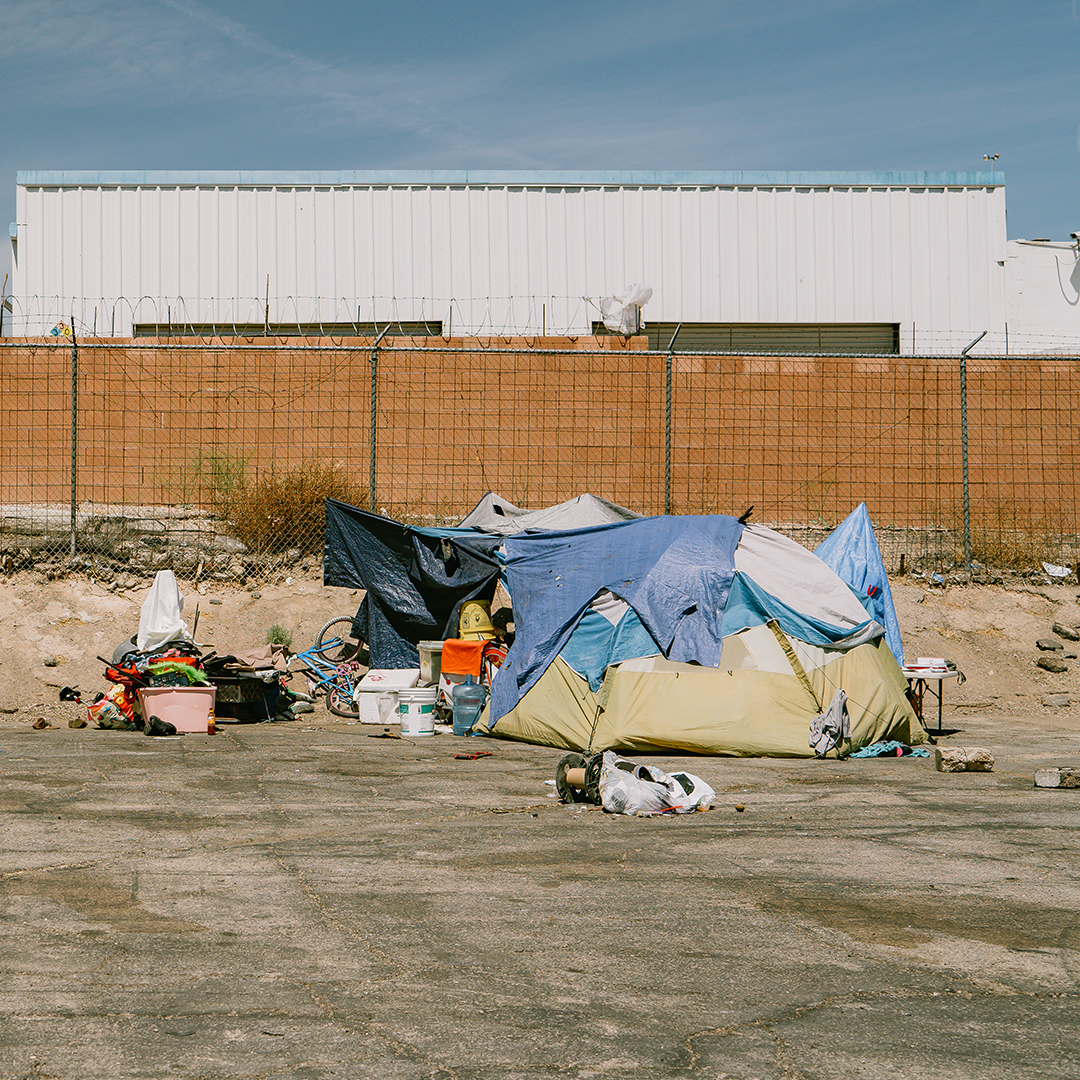
Helen, thinking about her time living as an unhoused person, lowers her head when I ask about her own isolating experiences. She extends her hand, gesturing beyond the large Tesla dealership sitting behind the HELP/SNHD caravan parked in the middle of the homeless encampment, to point to a smog check station in the parking lot of an auto repair shop. “Sometimes, during (hot) days like this, I go over there with my little wagon (to get water),” she says. “And if they come outside and say something to me, I just look at them and shake my head. I say, ‘You know what, you don’t even pay for this water, it’s not yours, come on.’”
Her voice cracks as she recalls an especially traumatic experience surrounding an inability to find drinking water. “I just had a friend, a best friend of mine, last July, die from dehydration. Nobody would give him water. Broke my heart.” Her friend, who was on the autism spectrum, had been out of jail for only two days before his death.
Social workers like Barr say processing this kind of persistent, daily trauma leads some to use substances in an attempt to mentally cope. “They’re in misery,” Barr says. “Imagine being on the street right now in Vegas. It’s 110 degrees outside, it’s horrible, it’s miserable. Why would you be sober in such an environment?”
He references the famous 1970s “rat park” study, wherein researchers found isolated, bored, and stressed rats consistently chose drug-laced water. Happy rats with adequate social stimulation did not. “(When you’re unhoused) you’re the rat in the cage,” he says. “I’d be pressing the lever too.”
“You’re afraid to sleep because of violence or being robbed and losing all of your items. Well, one good way not to have that happen is to be on meth ...”
Louis Lacey, HELP of Southern Nevada
The flip side of that, Barr adds, is drug use’s role in social networks. He says, “If you’re around people who are using it’s a way to bond,” which can be critical to creating and maintaining safety structures on the street.
Then there’s the fear that pervades the homelessness experience. “There’s some younger guys that come around, and you can tell that they’re up to no good,” Helen says. “I feel like they’re rapists. One of them, he gives me the creeps every time he comes around, so I try not to come out of my tent. ... If you go to sleep, you better sleep with everything that you want, you know? Because sometimes you don’t get sleep out here.”
Lacey says a fear of sleep — and the vulnerability that comes with it — is common, and drug usage can extend into this, more utilitarian, sphere. “Especially with methamphetamines,” he says, “if you’re on the streets, you’re afraid to sleep because of violence or being robbed and losing all of your items. Well, one good way not to have that happen is to be on meth and be able to stay awake for extended periods of time.”
Good regulatory intentions have also accidentally paved a road to suffering, says UNLV’s Kraus. “The reason many people went to fentanyl is not because they wanted it. It’s because when we actually took away many of the excessive prescriptions for opioids, what you got was diversion.” So, Kraus says, people who got hooked on opioids through prescription use shifted their habits to include fentanyl. Thus, “fentanyl became very cheap and very available.”
Very cheap and very available, on the other hand, does not apply to the treatment landscape.
The Response
Another insight from the California Statewide Study: 20 percent of unhoused respondents reported a desire to receive treatment for active substance use but were unable to receive it.
It’s not much better in Nevada. Ninety-one percent of Silver State residents live in a federally designated mental health professional shortage area, according to a 2025 research brief from UNR’s Nevada Health Workforce Research Center. That care is equally hard to come by for housed and unhoused people. The state was simultaneously ranked 47th worst in the nation for access to mental health care and 46th worst for our prevalence of substance use disorder by Mental Health America’s 2025 report. That same report indicated that 78 percent of Nevadans with substance use disorder who needed care were unable to access it.
Even when unhoused people do make it into treatment programs, experts say, that doesn’t mean they actually receive treatment.
“Often, programs don’t have enough funding, or they don’t have enough resources, or the requirements to maintain your eligibility for these programs are too rigorous,” says Ashley Bunn, the Las Vegas Rescue Mission’s Lighthouse Recovery Program supervisor. As a result, throughout the various stages of substance use treatment, Bunn says, the unhoused learn to distrust institutions, and eventually might not want to reach out for help at all.

It’s why outreach and social workers, like the Homeless Response and Street Medicine teams, are so adamant about following through on promises and building trust through consistency.
The Street Medicine Team provided care to 158 unique patients between November 2025 and this May. More than 70 percent of them were enrolled in Medicaid. This, Barr says, is another pressure point for people already in active homelessness and on the margins of it, because of Medicaid eligibility changes, approved last summer, mandating that all able-bodied adults log 80 work or volunteer hours monthly to receive their benefits.
“People experiencing homelessness are medically fragile. One of the feeders to being homeless is medical debt and medical problems that make it so you can’t work. So, for sure, as Medicaid cuts go into effect, you will see an increase in homelessness,” Barr says.
Beyond Medicaid losses are the two encampment ordinances on city and county books, which took effect in late 2019 and early 2025, respectively. These bans penalize the act of sleeping outside in public parks, washes, trails, and on sidewalks, imposing fines and possible jail time. Law enforcement’s shuffle of the unhoused, dispersing and detaining people in encampments, can complicate aid workers’ efforts among a community already prone to periodic migration. “With everybody moving all the time, that can be hard to keep the continuity of care going, because everybody could be here this week, and then next week they’re over there, and we may not even run into them for a month or two,” Lacey says. While unavoidably having to enforce these bans, officers with the Las Vegas Metropolitan Police Department have tried to soften the impact of moving folks, and now have a dedicated homeless Hope and Outreach Team. “The trust is not built overnight due to some unhoused, in the past, not approaching law enforcement because of negative impact, because of arrests, because of the tone,” says Annie Wilson, Metro’s HOPE Liaison. “We have changed the culture of Metro. A lot of times when we’re out there with the unhoused (now), they’ll come up to officers in uniform and say, ‘Hey, we need help.’”
And providers and advocates are quick to point out that there is even more reason for optimism.
Numerous facilities are expected to come online by the end of the decade, the most ambitious of which is the controversial 900-bed Campus for Hope. The facility’s plans say it will provide on-site substance use and addiction services, in addition to housing, job training, and legal help. Slated to open on the eastern boundary of CSN’s West Charleston campus, it’s been beset by lawsuits from residents in surrounding neighborhoods citing a possible uptick in crime and lower property values. Campus developers argue it’s designed to be a referral-only shelter, so it won’t accept clients from or release them onto surrounding streets.
The Las Vegas Rescue Mission, just south of the city’s so-called “Corridor of Hope” service hub, also has expansion plans for its Lighthouse Recovery Program to help people exit addiction. Through a capital campaign, the Mission hopes to raise $85 million to double women’s recovery beds from a couple dozen to 50.

Another such facility, the Clark County Opioid Treatment Center, is currently in the design phase. Over the summer, Clark County Commissioners approved $126 million to fund the first-of-its-kind center, planned for the northeast area of Las Vegas. That funding, according to the county, comes from several 2022 multistate settlements with opioid manufacturer Johnson & Johnson, as well as a handful of opioid distributors.
Commissioner Marilyn Kirkpatrick says the 240-bed center will focus on rehabilitation. “A lot of people ask, ‘Where’s the opiate dollars?’” she said during a June hearing. “This is where our opiate dollars are, into building a treatment center —
a long-term facility with different types of beds, so that people can get the care that they need not only for the short term, but (also) the long term.”
Notably, the Southern Nevada Health District, home of the Street Medicine Team, is the largest city health department to have received no direct opioid settlement money. “We’re challenged,” Cassius Lockett, SNHD’s district health officer, said at April’s State of Public Health event. “We’re in the midst of applying to several grants at this moment so we can continue the journey and make a dent in this effort” of funding the Street Medicine Team. Yet, that hasn’t hindered the work of the team, or the broader effort to reduce the region’s opioid overdoses, primarily through increasing fentanyl and xylazine test strip availability, targeted overdose outreach, more education, and — most quantifiably — more opioid reversal medication distribution.
“In 2020 we distributed about 5,500 doses (of Narcan), and then by 2025 that number increased to 212,000 doses. That’s more than a 38-fold increase compared to 2020,” SNHD’s Delise says. That indicates Clark County has reached what officials call “Naloxone saturation” — the amount of Narcan needed to cover at least 80 percent of witnessed overdoses.
He emphasizes this milestone is a key explanation for the County’s 20-percent overdose decline since 2024. “In 2025 the health district met and exceeded that (Naloxone) threshold for the first time,” he says.
A large share of this medication passes through the hands of SHND and HELP’s street outreach staff. “God bless Narcan,” Lacey says, raising his hands to the sky in praise. “Last week we got 4,000 doses from (SNHD), and we’re giving that much away. We’ll (give out) 4,000 doses in about less than three months.”
This, experts say, is a reason to be hopeful. But change is incremental, and in the meantime, as markers of the crisis slowly improve, the immediate and long-term impacts continue.
The Future
“About a month ago we had a youth who was about 22 or 23 years old who had overdosed right in front of us,” recalls Lacey, shaking his head. “Fell out, we Narcaned him, called for medical backup, medical arrived. The youth was revived, refused medical treatment, refused substance abuse treatment, detox, anything. Yesterday, we were conducting an outreach in that same area, and we were informed that the day before that youth died in an abandoned building from an overdose.”
Suffering, Lacey is implying, continues, and will so long as the system allows Southern Nevadans to slip through the cracks.
“We have a very poor social safety net here,” Barr agrees. “We don’t want to pay taxes to have a good social safety net, and so this is the result.”
This, advocates unanimously echo, is the core problem with the rhetoric of L.A.’s Pratt. “It’s failing to acknowledge all the things that were system failures,” Bunn says. “There are just a bunch of points along the way where somebody probably could have scooped them up, could have contacted them, could have assisted them. And that didn’t happen for some reason or another.”

But the stigma this rhetoric reinforces, the Rescue Mission’s Bunn adds, can also deter people from seeking help in the first place. “Why am I going to reach out to a society for help, or any of the entities that are part of that society, when this is how they talk about me, when this is how they look at me?”
Barr directs the blame beyond local institutions to a deeper cultural problem. “America hates poor people,” he says. “People who use drugs who are successful don’t really have the stigma.” He cites studies indicating that just being housed reduces a person’s proclivity to turn to substances — but, he acknowledges, this can be an expensive solution.
“I just don’t think there’s much appetite in our society for this. People say, ‘Well, I’m working hard, I’m struggling. Why do I want to give my money to this person?’ I just don’t think there’s a lot of appetite for paying for really high-quality long-term residential rehab,” Barr says.
The more entrenched chronic homelessness becomes, the more substances people use — and the longer they go before receiving detox services. All this can have permanent impacts on people’s future health, Bunn says.
“I don’t know if it’s our Las Vegas heat, but there is something (about) when you combine methamphetamine use with homelessness and not really staying hydrated,” she says. “We have just seen like a lot of really strong psychosis, paranoia, hallucinations, which are a lot of symptoms that you don’t necessarily get with some of the other substances.” These symptoms don’t seem to go away or level out after sobriety for some people. “There are some people who, some of that stuff stays with them,” potentially affecting future prescriptions they’ll need to take, employment prospects, and their quality of life.
The Rescue Mission’s Martinez acknowledges that it can be difficult to strike a balance between acting quickly and being thoughtful about policy and funding allocations. But the legislative tendency is to throw the baby out with the bathwater. “We’re quick to make a decision on what to cancel, but we’re not equally ready to match it with a program that’s going to capture the outliers,” Martinez says. “We need to figure out a system that potentially works, and if it doesn’t, fine tune it. Don’t necessarily get rid of it.”
“We really need to take our feelings out of it if we want to be effective,” Barr concurs. “We may have a lot of judgment towards people who are using and homeless, but letting those emotions drive policy, it simply will not work.”
Lacey frames his own response in a moral way. “How do we judge ourselves as a community? It is how we deal with the least of these.”